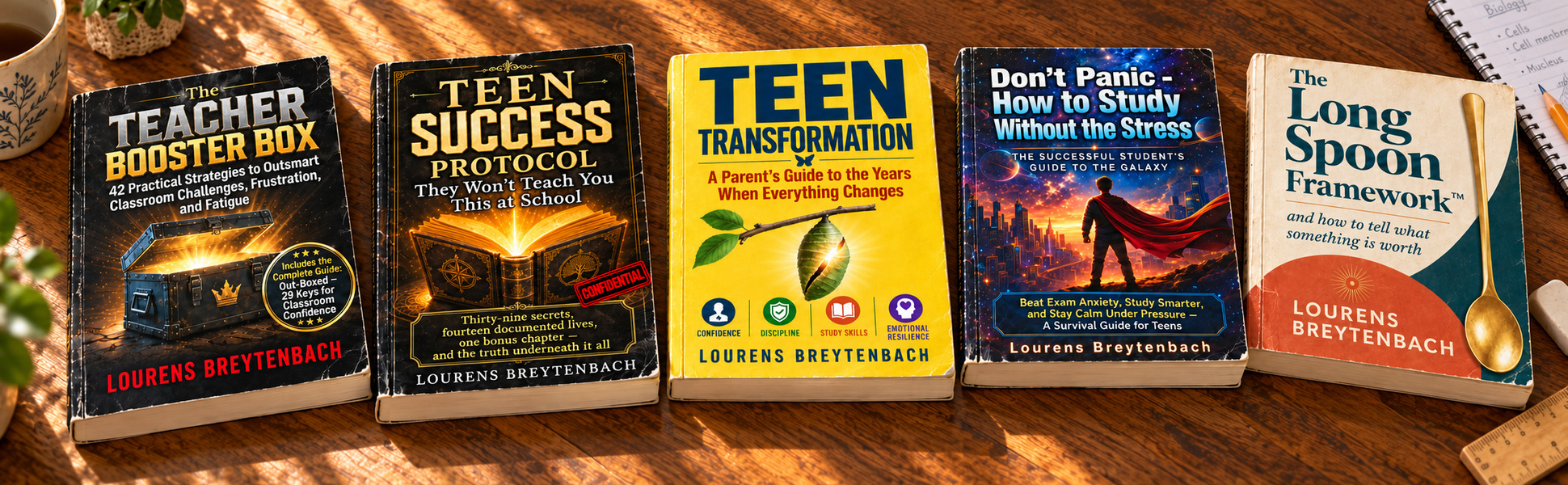
Five books on learning, study and the teenage years · lourensbreytenbach.com/books · This is the sixth
Not through lack of study. Through thirty small, avoidable mistakes that able students across the world make in the last two weeks and the first two minutes of an exam. I have watched them happen for thirty years. This year I have written them down.
The five below are a fair sample of the whole. They may be enough on their own; if they are, I am glad to have helped.
Five books on learning, study and the teenage years · lourensbreytenbach.com/books · This is the sixth
Picture the morning the results come. Your daughter opens the envelope. Seventy-nine. One mark short of the distinction she had been two marks ahead of in every test this year.
Now picture a teacher beside you who can point to the exact question where that mark went. She knew the answer. She wrote it down. Then she "checked" it by reading it again, felt a flicker of doubt, and changed it to the wrong one. It took her eleven seconds.
What would that one mark have been worth, had someone explained those eleven seconds to her a fortnight earlier?
Able students are seldom failing. They are stalled at 74, 78, 79, and each of those numbers is a bundle of small mistakes that have little to do with how hard they studied and a great deal to do with how they handle the paper.
That is the whole of this book. Not more studying. Tuning the instrument.
These are not thirty tips invented in an armchair. I went to the places students go the night after an exam, once the adrenaline has faded and the regret has arrived: the hindsight threads. GCSE. A-level. AP. HSC. Leaving Cert. VCE. NCEA. Thousands of capable teenagers, in English-speaking exam systems on four continents, answering one question: what do you wish someone had told you?
Their answers are not what one expects. They are not "study harder". They are small, specific, quietly painful confessions. A student who worked until 4am for Chemistry and then misread the easy questions. A student who changed six correct answers because doubt felt like evidence. A student who left every paper after thirty minutes because "nothing more came to mind", and who still thinks about it years later.
Each of those confessions was then checked against what the examination authorities themselves tell schools: Ofqual, the Queensland exam-stress protocol, the HSC guidance, Dave Putwain's work on exam anxiety, Sian Beilock's research on performing under pressure. The ones that recurred, student after student and system after system, and were confirmed by the people who set the papers, became the thirty.
An AI assistant will offer a tidy list of "exam tips". These are something different: the thirty places where a well-prepared student quietly loses marks, described by the students who lost them.
Here are five of them. They read best with a recent test paper of your child's somewhere nearby.
Every teacher says "check your work". Few explain how. So the student re-reads their own working, and the brain that wrote it nods along: yes, that looks right. Of course it does. It is the same brain that made the error. Psychologists call this recognition bias, and it is why the final ten minutes of most exams achieve very little.
This is the one from the envelope. The answer is correct. Then, with four minutes left and the heart going, a feeling arrives. Not a reason; a feeling. And the pen moves. Students change far more right answers to wrong than wrong to right, and they tend to remember every one.
Highlighters. Three colours. Headings underlined twice. It looks like work, it feels like work, and a parent passing the bedroom door is understandably reassured. It is not yet work; it is copying. The brain has not been asked to retrieve anything, so on the day it has never practised the one thing the exam tests: producing the answer with the book shut.
Persistence is a virtue. In an exam it can become a trap. A hard question is a hole, and a conscientious student will keep digging out of sheer character, while twenty easier marks in Section C quietly expire. Moving on feels like giving up. It is, in fact, the most profitable decision on the paper.
The all-nighter is the most respected mistake in the world. It looks like dedication. The student walks in knowing slightly more and reading, reasoning and settling noticeably worse. The marks are not lost on the topic that was crammed. They are lost on Question 1, which could have been answered in Grade 9.
Those are five. Most parents recognise their own child in at least one of them. The remaining twenty-five are of the same kind.
There is a quiet assumption in the system that the paper will do what it has always done: separate the "naturals" from the rest, and leave your child where they have always landed. Seventy-something. Good. Not quite.
After thirty years in classrooms and exam halls, I believe that assumption is mistaken. The content work has been done. The teachers have taught, your child has studied, and there are no more hours left to buy. What remains is not studying. It is tuning the violin: the thirty small decisions between knowing the work and being credited for it.
The distance between 76 and 81 is seldom intelligence, and seldom effort. It is strategy, and strategy can be learnt in an evening, by a tired teenager, from a short book, a fortnight before the paper.
There is no dress rehearsal left. This is the performance, and your child can walk into it with a plan.
Every lesson has the same shape: the mistake, what it looks like on an ordinary Tuesday evening, the better decision, one action for the learner, and one practical note for the parent. No theory, and no "believe in yourself". Decision rules a sixteen-year-old can rehearse on Saturday's past paper.
Hours versus outcomes · the perfect timetable · vague planner entries · pretty notes · never rehearsing the pressure
The night-before mock · the all-nighter · phone "breaks" · the study spot that keeps failing · the panic circle · the car-park post-mortem
The experimental breakfast · the wrong session · packing in one's head · arriving too late, or too early
Starting at peak adrenaline · not scanning the paper · the time-sink question · staying stuck
"Silly mistakes" · checking by re-reading · changing right answers · mental arithmetic · command words · leaving early
Improvising calm mid-panic · hiding distress · one bad paper treated as a verdict · and a gentle one for parents
At the back: a two-page parent guide, a session planner, a recurring-error record, an exam-readiness checklist, a time plan for any paper, and a one-page family support agreement for exam week.
Some of the thirty will look elementary. "My child would never." Then Saturday's past paper is watched with new eyes, and three of them appear in the first ten minutes. That is rather the point: the mistakes are simple, which is why they survive. The aim is not a transformation. The aim is the one that is worth the one percent.

I am Lourens Breytenbach. I have taught English and Mathematics for thirty years, and for a good part of them I have run examinations: the timetables, the invigilation, the scripts coming back in boxes. I have marked the 79s. I have sat with the parents afterwards. I know where the marks went, and it was almost never where they thought.
The credentials matter less than this. It seems to me unjust that a bright student's 74% is read as a verdict on the student, when it is so often a verdict on eleven seconds of poor checking. The content has been taught. The studying has been done. The last few percent is technique, and almost nobody teaches it, so I wrote it down.
Not the first book. The most focused one.
A few of the students who have used these systems:
Sanay recently wrote his own letter to this year's matrics on my Substack, "What I wish someone told me before". A former Head Boy, unprompted, explaining that re-reading notes creates a false sense of knowing, and that "sometimes the smartest thing you can do is close the book." He learnt that here. It takes an evening.
More at lourensbreytenbach.com/testimonials.
One dollar for every year I have spent in the classroom. Less than an hour of tutoring.
The price is the same for everyone and does not change; there are no coupons, timers or further offers behind it. Nor are there refunds: the five lessons above are a true sample of the whole, and if they did not land, I would rather you kept your money.
One honest line, because the book says it too: no book can promise a mark. What it can do is give the knowledge your child already has a fairer chance of appearing on the page. That fairer chance is the one percent.
Papers are being written this week, somewhere, by somebody's child, and in each one written without the thirty, the marks will have gone to the same five places they always go. Tuesday cannot be rewritten. Thursday can still be prepared for.
This is the first season these thirty have been published. When the season ends they go back in the drawer until next year, which, for this year's candidates, would be too late.